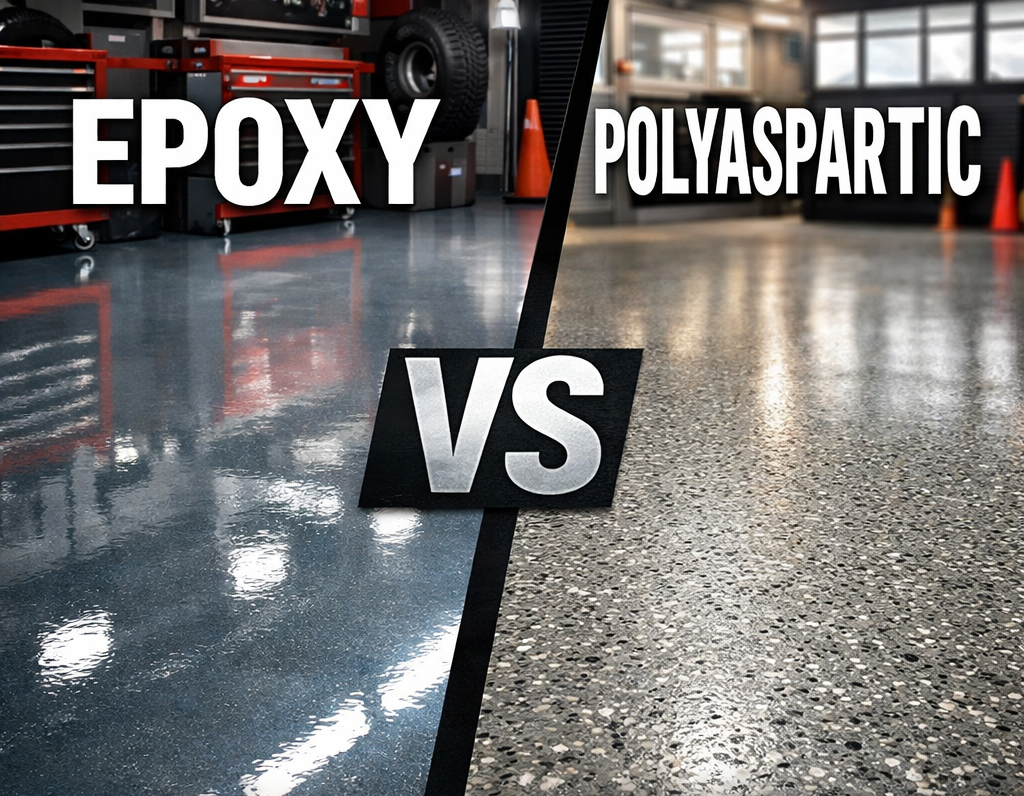
EPOXY VS POLYASPARTIC GARAGE FLOOR COATINGS: WHICH ONE IS RIGHT FOR YOU?
Our garages are more than just parking spots. They’re workshops, storage hubs, and the first impression of our homes. That chipped, stained concrete is probably driving you a bit crazy. You’ve likely heard that a professional coating is the answer, but then you hit a wall of confusion: Epoxy vs. Polyaspartic.
Don’t worry, by the end of this guide, you’ll have crystal-clear clarity on which coating is the champion for your garage, your lifestyle, and your peace of mind. We promise to cut through the jargon and give you the real-world facts you need to make a confident decision.
EPOXY FLOOR COATING EXPLAINED
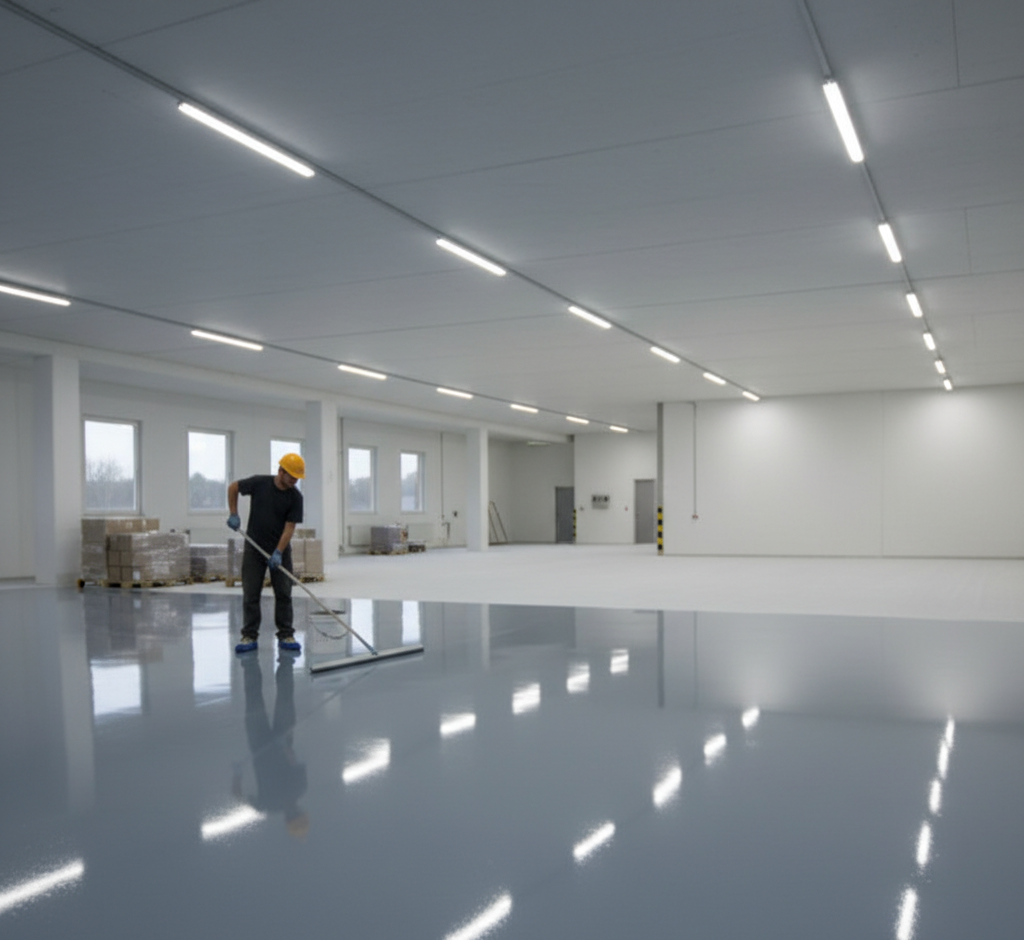
Let’s start with the name you’ve probably heard the most: epoxy floor coating. Think of epoxy as the incredibly strong, reliable workhorse of floor coatings. At its core, epoxy is a two-part system: a resin and a hardener. When these two components are mixed, a chemical reaction occurs, creating a rigid, plastic-like surface that bonds tenaciously to your concrete slab.
The technical magic of an epoxy floor coating lies in this bond and its cross-linked polymer structure. This creates exceptional compressive strength, meaning it can handle the weight of your car, heavy tool cabinets, and anything else you roll into the garage without a dent. It’s also highly resistant to the chemicals we commonly spill, Oil, brake fluid, and harsh cleaning agents. The surface is non-porous, so those spills simply wipe up instead of soaking in and leaving a permanent stain. Furthermore, the aesthetic possibilities are vast. From solid colours to decorative flakes and even stunning 3D Epoxy Flooring Solutions, epoxy allows for immense creativity.
POLYASPARTIC FLOOR COATINGS EXPLAINED
Polyaspartic coatings are a newer generation of protective floor systems that build upon polyurethane chemistry. What sets polyaspartic apart is its rapid curing time and deep penetration into concrete. Unlike epoxy, polyaspartic coatings have a thinner viscosity, allowing them to soak into the concrete surface rather than just sitting on top.
These coatings can be installed and ready for use within a very short timeframe, sometimes within a single day. This makes them ideal for busy households or commercial garages where downtime is costly.
Polyaspartic coatings offer excellent resistance to UV exposure, which helps maintain color stability over time. They also handle temperature variations better during installation, giving more flexibility in project scheduling. While polyaspartic floors can also be decorative, they are typically chosen for performance driven applications where durability and fast return to service matter most.
KEY COMPARISON FACTORS: EPOXY FLOOR COATING VS POLYASPARTIC SYSTEMS
When comparing epoxy floor coating and polyaspartic systems, it is important to look beyond surface level differences.
Bond strength and penetration:
Epoxy floor coating forms a strong bond on properly prepared concrete, creating a thick protective layer. Polyaspartic coatings penetrate deeper into the concrete, forming a mechanical bond that enhances long term adhesion. Both systems perform well when installed correctly, but the bonding mechanism differs.
Curing time:
Epoxy floor coating typically requires longer curing times between coats and before full use. Polyaspartic coatings cure much faster, allowing quicker project completion. This can be a deciding factor for clients who cannot afford extended downtime.
Thickness and build:
Epoxy systems are generally applied in thicker layers, which can help level minor imperfections. Polyaspartic coatings are thinner but often applied in multiple layers to achieve the desired performance.
Design options:
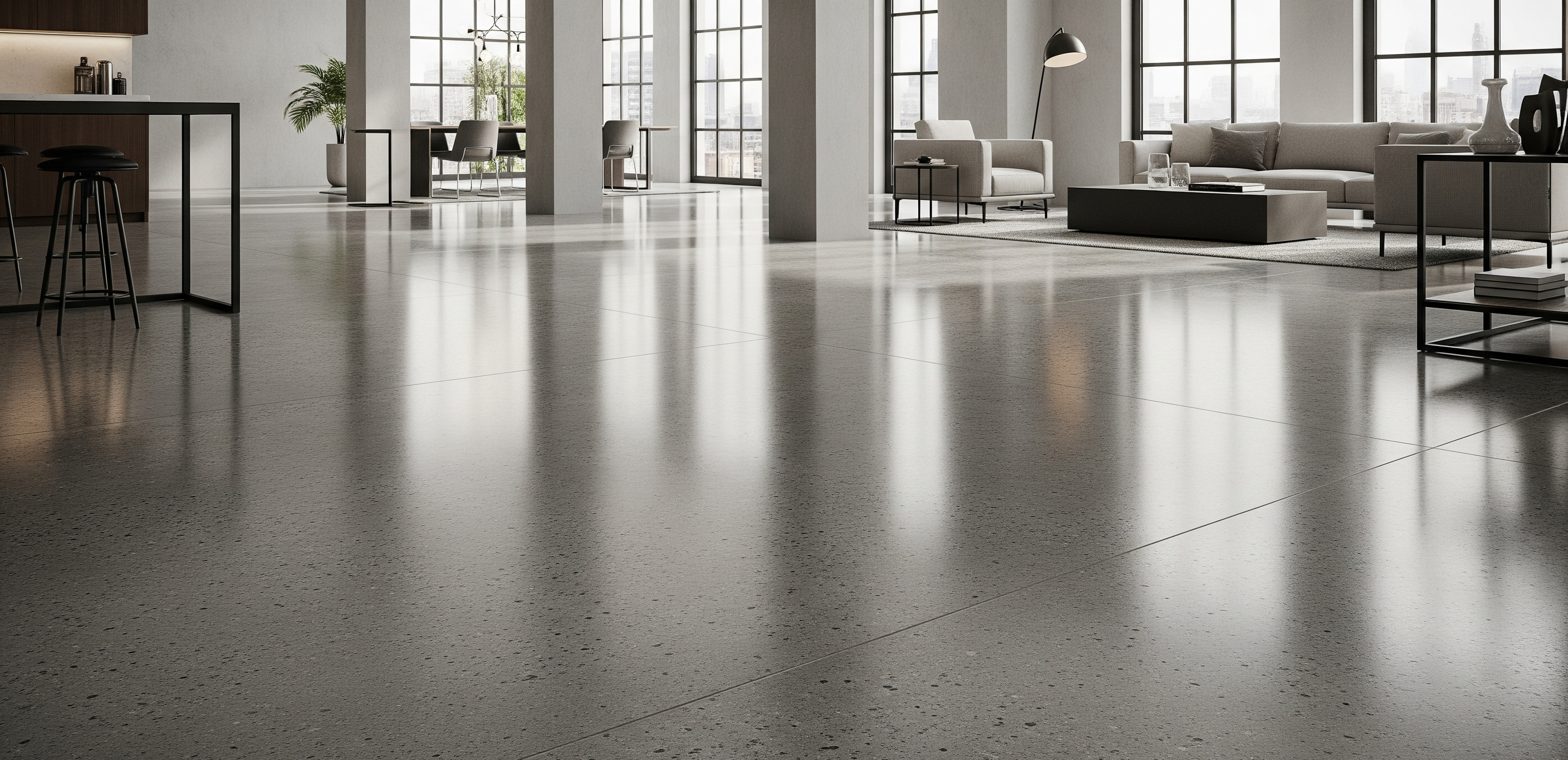
If aesthetics are a priority, epoxy floor coating offers unmatched creative options, including metallic finishes and 3D Epoxy Flooring Solutions. These systems can turn a standard garage into a visually striking space. Polyaspartic designs are subtler but still clean and modern.
Maintenance and longevity:
Both systems are easy to clean and maintain when installed by professionals. Routine sweeping and occasional washing are usually enough. Longevity depends on usage, preparation quality, and installation expertise rather than just the material itself.
CHOOSING THE RIGHT OPTION
Choosing between epoxy floor coating and polyaspartic is not about which one is better overall. It is about which one is right for your specific needs.
Choose an epoxy floor coating if:
Your priority is a proven, cost-effective solution with maximum chemical resistance. You are planning a highly decorative floor with flakes or metallics and don’t mind the garage being out of commission for up to a week.
Choose a polyaspartic coating if:
Speed and minimal disruption are your top concerns. You need the garage back in service within 24-48 hours. You have concerns about potential moisture in the concrete slab, as its faster cure reduces sensitivity. You want the ultimate in UV protection to keep the colour pristine, especially if your garage gets direct sunlight.
For those seeking a truly breathtaking visual impact, combining both technologies is a masterstroke. 3D Epoxy Flooring Solutions often use a deep-pour epoxy to create the stunning dimensional art layer, which is then sealed and protected with a clear, tough polyaspartic topcoat. This gives you the best of both worlds: limitless beauty and maximum, long-lasting protection.
CONCLUSION
Your garage floor is the foundation of a space that serves you and your family. It deserves a solution that’s as resilient and thoughtful as the life you live there. Whether you lean towards the sturdy reliability of epoxy or the swift strength of polyaspartic, making an informed decision is the first and most important step. You now have the knowledge to move forward with confidence.
Recent Post